Tudor, Greenland and The Ranger
From Greenland in 1952 to the 2025 Ranger, Tudor has always had a wrist in the expedition watch...
When it comes to our planet and the monitoring and exploration of it, computer-driven machines now do a lot of the work for us. Storm patterns are predicted by computers, seismic reactions are electronically modeled and computer-flown drones can give us real-time high-definition pictures of any part of this planet or other planets. But it hasn’t always been like this and back in the analogue era, humans were sent out into the unexplored territories to carry out scientific research to help humanity better understand our planet.
The analogue era relied on analogue communication and timing, and the development of the wristwatch made it perfect for the great early-to-mid 20th century explorers to carry for time keeping. Precise timekeeping was an important safety concern for the teams who investigated extreme climates and locations. These expeditions were the perfect opportunity for watch brands to test their products to their climatic and physical limits.
Testing Testing…
Hans Wilsdorf was a man who saw an opportunity to support expeditions to both test his watches and capitalise on the incredible advertising opportunities they offered. He was confident that not only could his timepieces handle the conditions, but also they would thrive and work flawlessly.
The first Tudor Oyster watches were sold in 1946 and housed manual wind movements. The Oyster Prince was unveiled in 1952; ‘Prince’ signalling an automatic movement and the equivalent of the Rolex ‘Perpetual’. The early watches were of what collectors refer to as mono-block construction (or monoblocco in Italian) where the mid-case and bezel are made from one piece of steel.
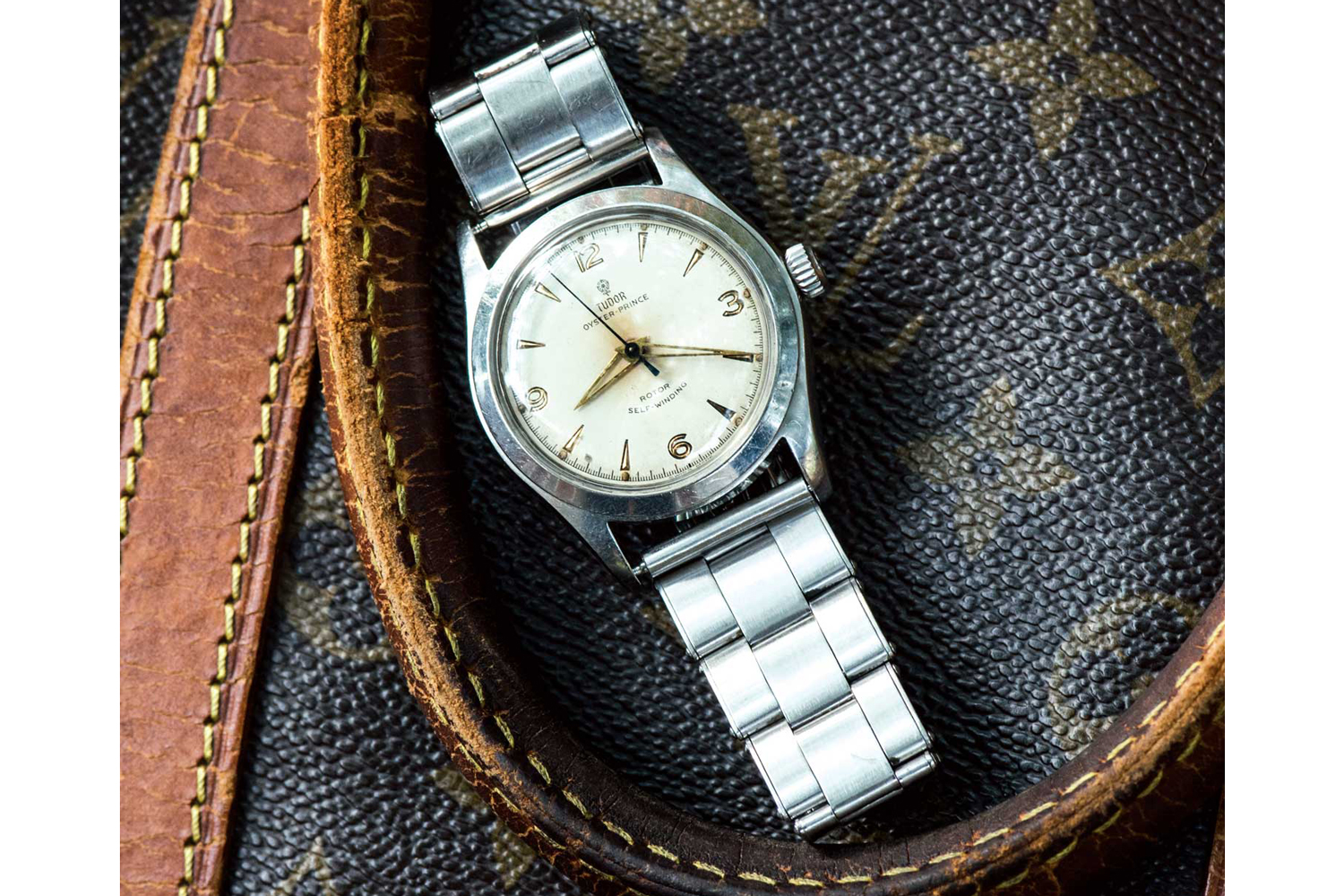
A 1952 reference 7808 Oyster Prince (Tudor Collector)
The Oyster case refers to the screw down winding crown, screw on case back and pressure fit crystal, all of which combine to create a waterproof watchcase that is hermetically sealed like an oyster. Truly rugged in construction, these watches were conceived as pieces to be worn for all rugged occasions as highlighted in early Tudor Oyster adverts featuring construction workers, motorbike racers and polar explorers. And there was no more rugged test for the watches than an expedition to Greenland.
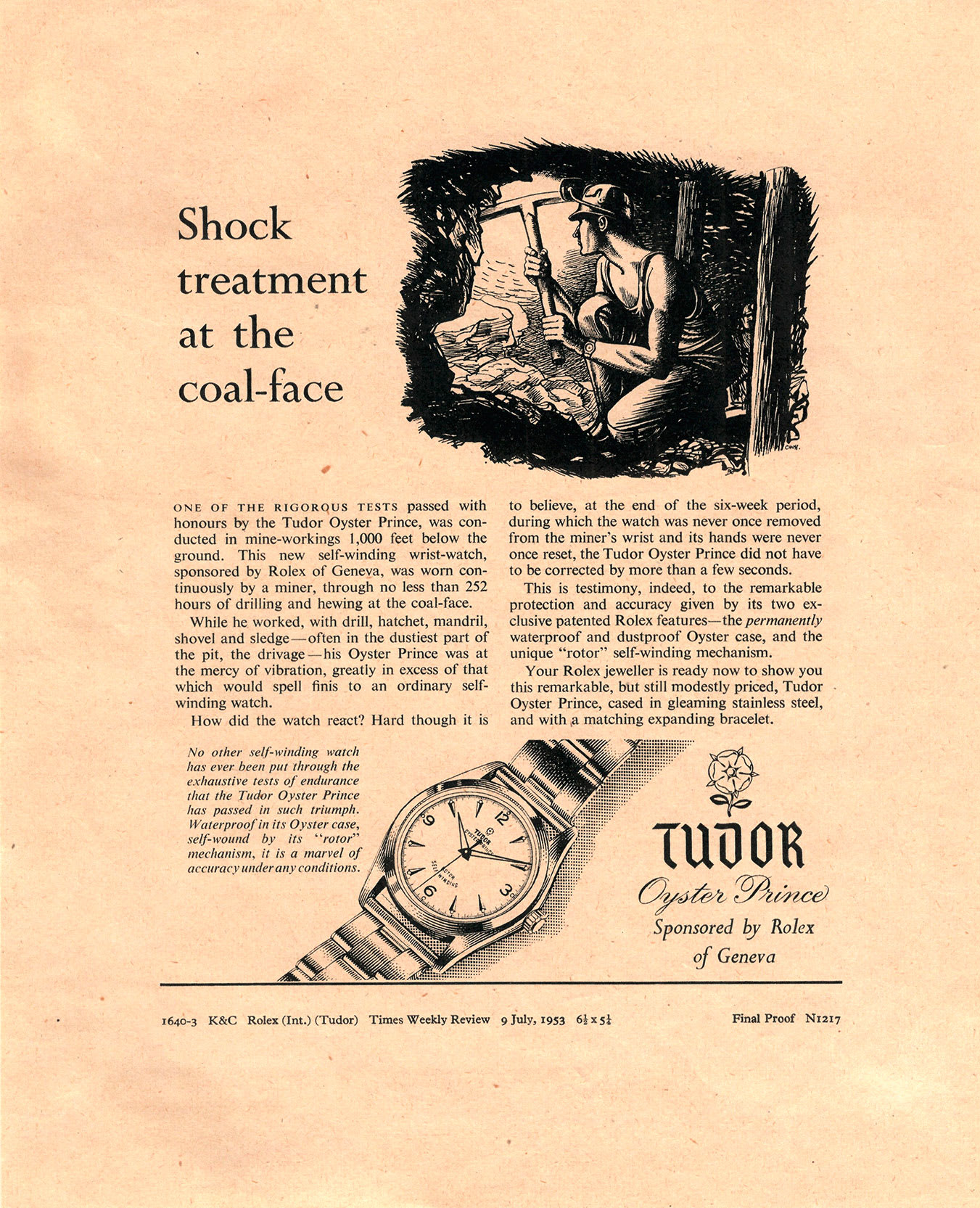
A 1953 Oyster Prince 'Trails of Destruction' advert (Tudor Watch)
BNGE
The British North Greenland Expedition (BNGE), led by Commander James Simpson, was commissioned by HRH Queen Elizabeth and Winston Chrchill to survey and research the ice cap. A total of 30 men took part in the expedition over the two years and were made up from representatives of the armed forces and the various scientific fields including the areas of geology, meteorology, glaciology and physiology. As well as research work, it was also an opportunity to train the military servicemen in Arctic conditions. The expedition was almost entirely carried out by the British, but the Danish Army did provide a Captain, an army surveyor, who was sadly the one fatality of the mission in 1953.
Denmark colonized Greenland in 1721, but officially the Kingdom of Denmark adopted the island in 1953, right in the middle of the BNGE. There would have been a lot of political activity in Denmark at this time and so I expect that it was a diplomatic necessity to have a representative of Denmark on the BNGE. In 1979 Greenland gained Home Rule and then Self-Government in 2009, making it effectively self-ruling but within the Kingdom of Denmark.
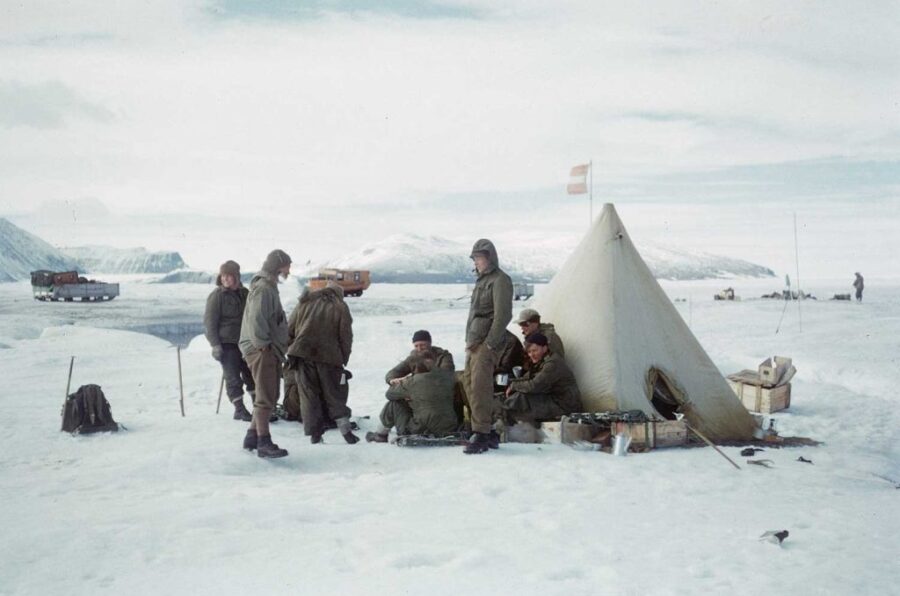
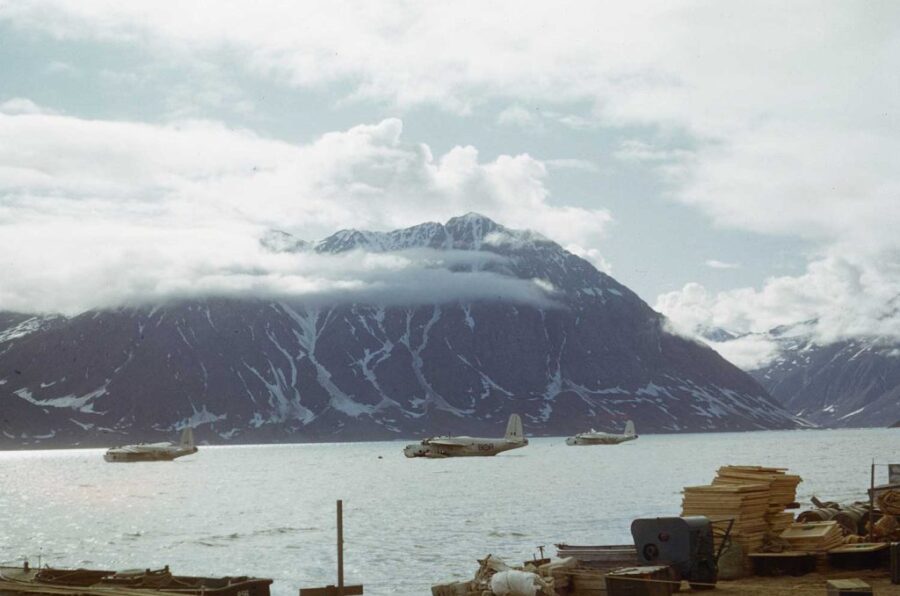
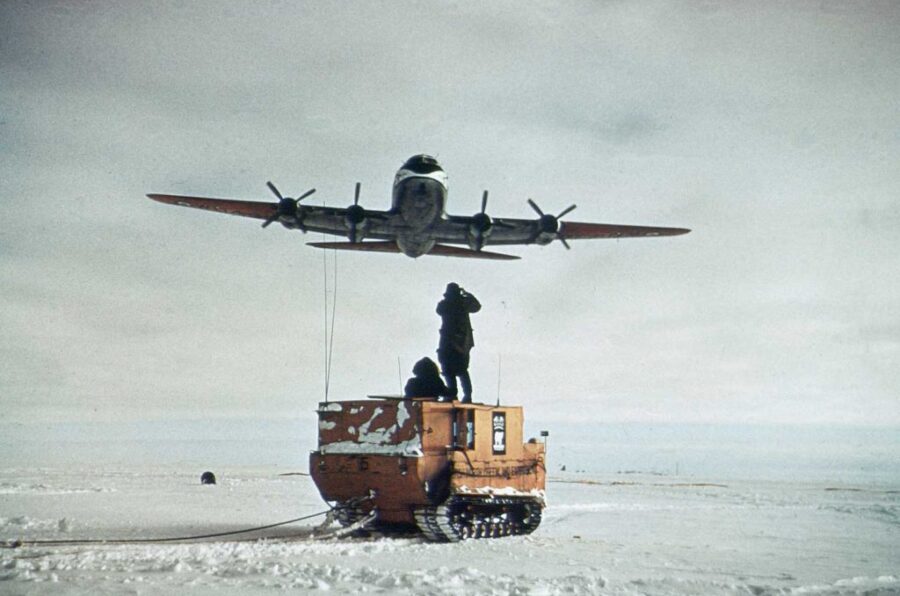
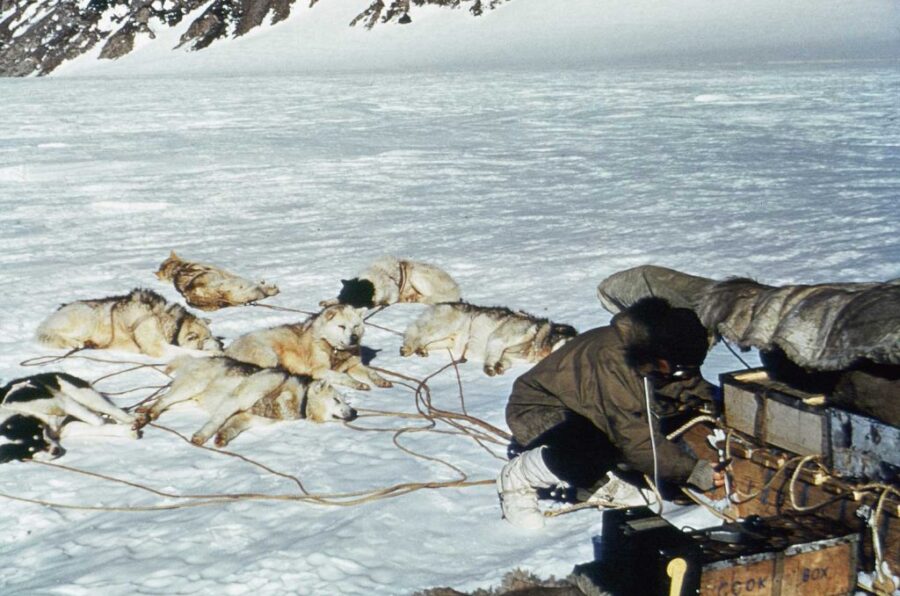
The work on the BNGE was carried out from two basecamps, the first at the glacial lake Brittania So (a name given to the lake for the expedition) and a second camp North Ice, which was 230 mile west of Brittania So. Travel around the island was via either dog-pulled sledges or Studebaker M29s, which were military tracked vehicles known as Weasels that were designed for use on snow. The mission began somewhat dramatically when one of the RAF supply planes, making supply and equipment parachute drops, got caught in a blizzard white-out and had to make an emergency landing. Everybody survived, but they had to be rescued by the United States Air Force over two days’ worth of rescue missions.
Tudor Oyster Prince
According to records, the expedition was supplied with 30 Tudor Oyster watches, reference 7808. These watches were mono-block pieces, with the one-piece case featuring the screw-down crown and case back. The watches were delivered on brown leather straps and were visually not dissimilar to the Rolex reference 6098 Pre-Explorer ‘Ovettone’ watches that were provided for the 1952 Everest expedition.
The Tudor 7808s that were supplied were regular production watches, with the small exception that the movements were lubricated with what Tudor called Arctic Oil. This oild was specially formulated to function at extremely low temperatures. We believe that the batch of loaned watches housed two different dial configurations. One dial version had simple baton hour markers and a double baton at 12 o’clock. The second dial variation resembled the Explorer watches that would come later from Rolex and the Ranger series from Tudor, with applied Arabic numerals at 12, 3, 6 and 9. We remain unsure how many of each dial was provided.
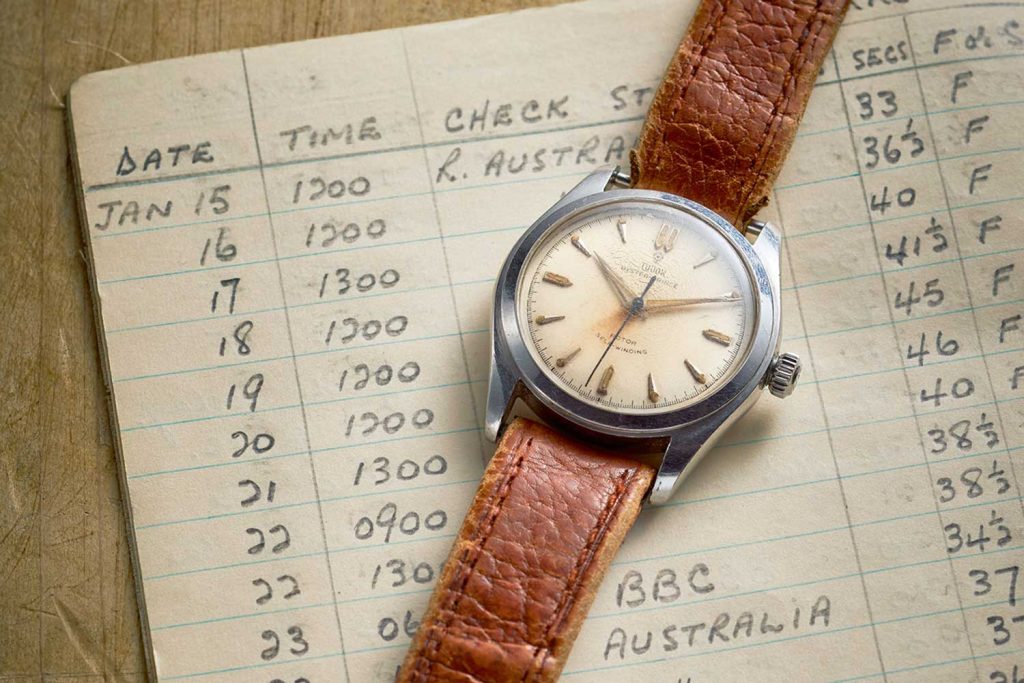
Roy Homard's 7808 with timing log (Tudor Watch)
A key part of the agreement between the expedition and Wilsdorf was the monitoring of time keeping of the Tudors. The team would check their 7808’s timekeeping against BBC radio signals and note the accuracy. These notes then formed part of the Tudor research and development programme and the company’s pursuit of excellence. One member of the team, the Officer in Charge of Vehicles – Captain JD Walker of the Royal Engineers, was very happy with his Oyster Prince. In a letter to Wilsdorf he stated that that having spent 13 months in Greenland he had “extreme admiration for the Rolex Tudor Oyster Prince which I wore on my wrist throughout my tour with the Expedition”.
The letter describes the extreme temperature changes from 70oF to -50oF and various tasks undertaken whilst wearing the watch including hut building, riding dogsleds, driving the Weasels and the watch inevitably being regularly immersed in water. He concludes, ”Despite these trials, occasional time signals broadcast from England proved that my Rolex Tudor Prince watch was maintaining a remarkable accuracy. On no occasion did it require to be wound by hand.”
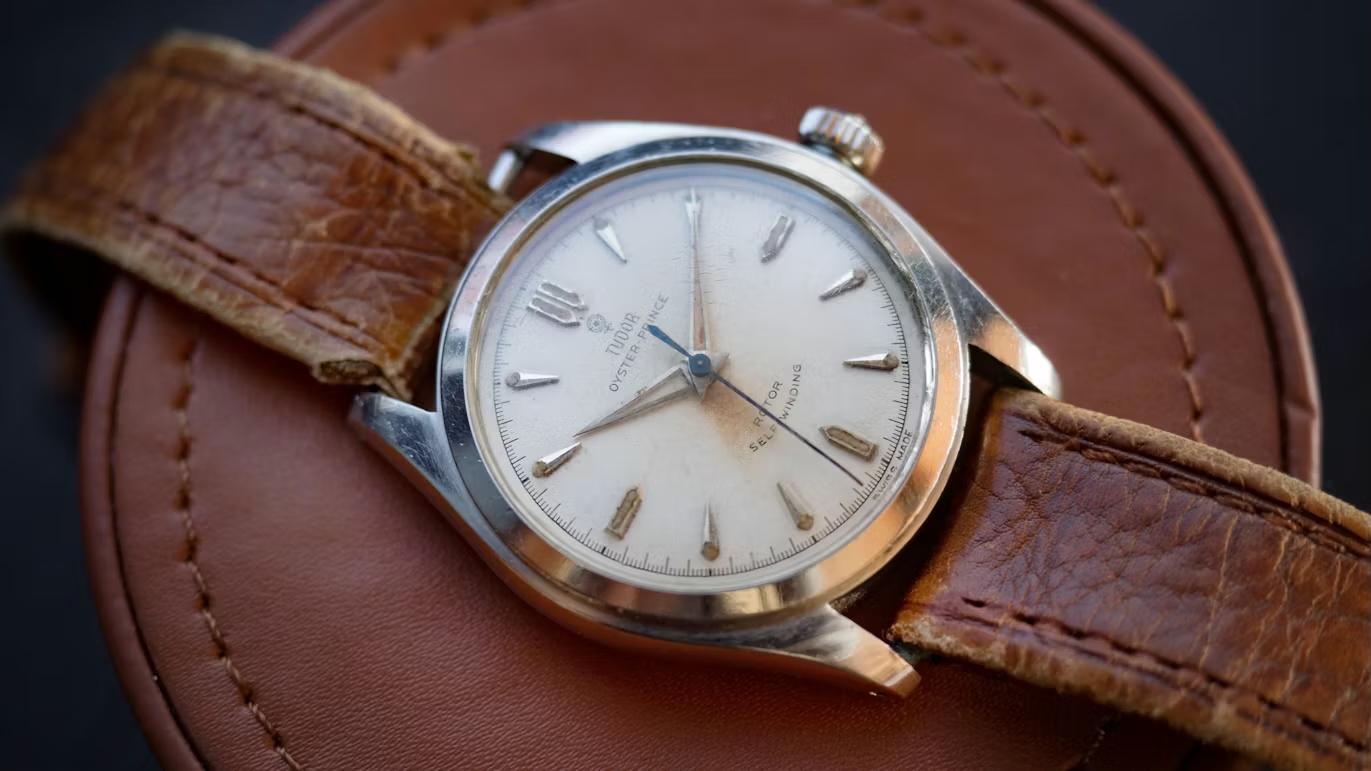
Homard's 7808 BNGE-worn Oyster Prince (J Forster)
Mission Watches
During my time of researching vintage Tudor watches, I have been fortunate enough to examine three watches that were given to members of the BNGE. The most noteworthy is the example that was given to Roy Homard, who joined the expedition in its second year. He was tasked with maintain the vehicles, in this case the Weasels. The work was difficult due to the extreme temperatures and Homard recounted that he would wear six layers of gloves and socks to combat the icy conditions. He worked alongside the seismic survey team, who carried out controlled explosions in the ice.
The readings helped determine the depth of the ice cap. 60 years after the event, the retired Royal Engineer, discovered his old Oyster Prince in a kitchen drawer. In a bid to breathe new life into the watch, which had long stopped working, Homard took the watch into the Rolex Service Centre. Eventually Homard donated the watch to the Tudor museum and as a show of appreciation he was awarded a Heritage Ranger by Tudor in recognition of his role in research and development work for Tudor all those years ago in Greenland.
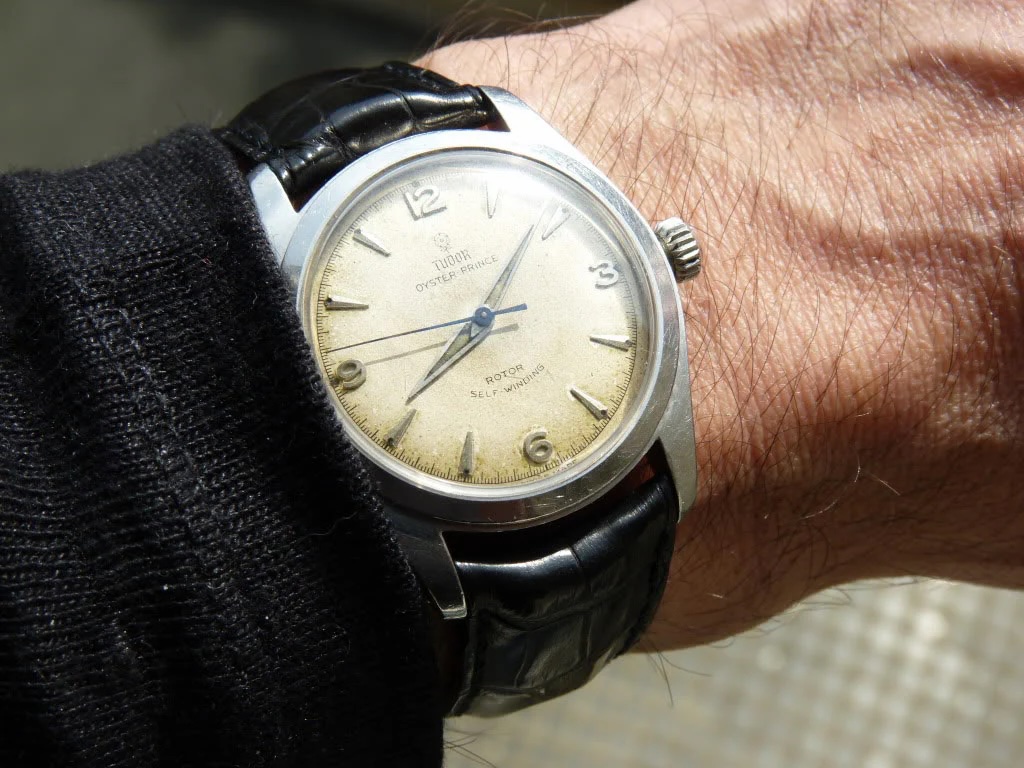
Chief Petty Officer Herbert “Dixie” Dean's BNGE-worn 7808 (M West)
Another important discovery was that of the Tudor 7808 that was issued to Chief Petty Officer Herbert “Dixie” Dean, who was a senior radio operator on the expedition. The Hubert Dean watch had the dial version with applied Arabic numerals, complemented by stunning dagger hands and a vibrant blued-steel seconds hand. The watch was discovered by vintage watch collector Martyn West, who lives locally to the cousin of Herbert Dean. I spoke to Martyn and he told me that Dean had left the watch to his cousin when he passed away. The cousin recalls being told that the watch was “issued to Dean as part of his military service when he was stationed in Greenland to support a scientific expedition”. As is often the case, she had forgotten about it. Much like the discovery of the Homard watch, Dean’s watch was rediscovered in a drawer. It wasn’t working and Martyn had it serviced and enjoyed wearing it for a while, before selling it to a collector in the Far East.
Perhaps the most well known of the three known examples is the one that belonged to the Medical Officer, Surgeon Lieutenant Jock Potter Masterton. JP Masterton was on the expedition for the whole two-year stretch and was a Royal Navy Reservist. His watch was discovered many years ago and bought by a French collector. It is, as per the other known examples, a reference 7808 Oyster Prince with a similar dial to the Herbert Dean watch. The Masterton watch is, interestingly, the only one to have a case back engraving. The engravings “JPM B.N.G.E. 1952-1954” were, I suspect, done commemoratively after the event.
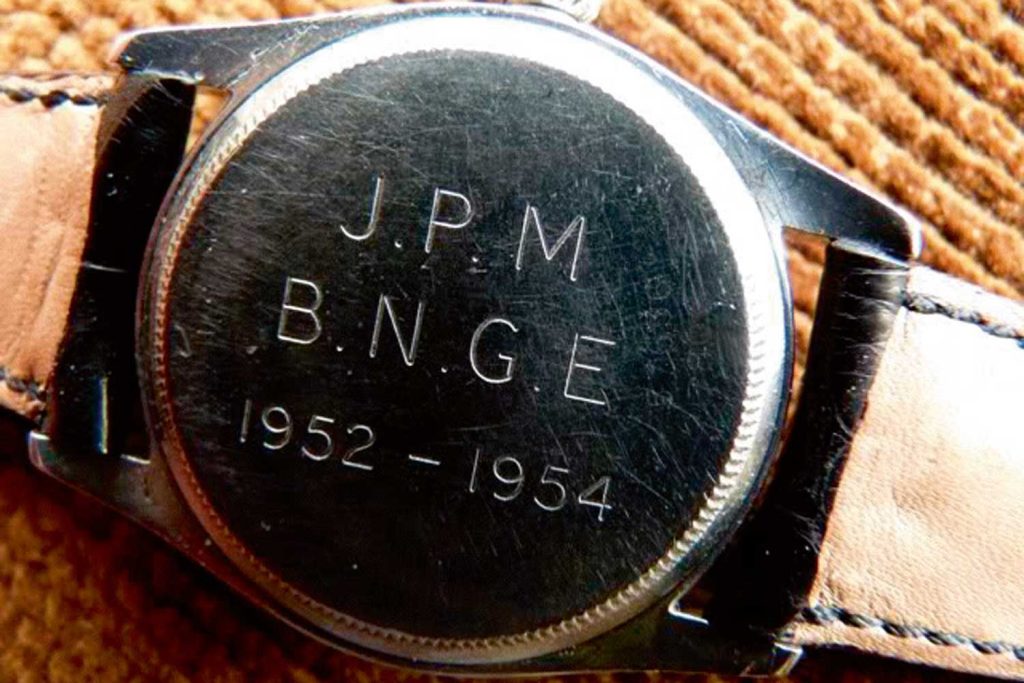
Commemorative engraving on a BNGE-linked 7808 belonging to JP Masterton (Tudor Collector)
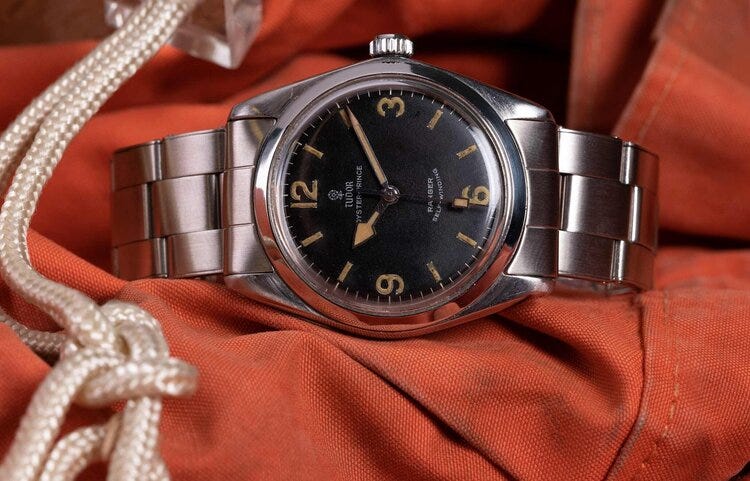
Tudor Ranger 'Rose Dial' (Tudor Watch)
The Ranger
The name Ranger conjures up images of rugged and purposeful pursuits and is associated with military and law enforcement in the main. Whilst not a direct descendant from the early Oyster Prince watches, in terms of nomenclature, the Ranger very much carries the spirit of intrepid exploration of the watches used for the BNGE in 1952. The name Ranger was actually registered by Wilsdorf in 1929 and the name was used on some dress watches in the 1930s. The Ranger was we know it though was a utilitarian watch with black dial and painted quarter-Arabic luminous hours.
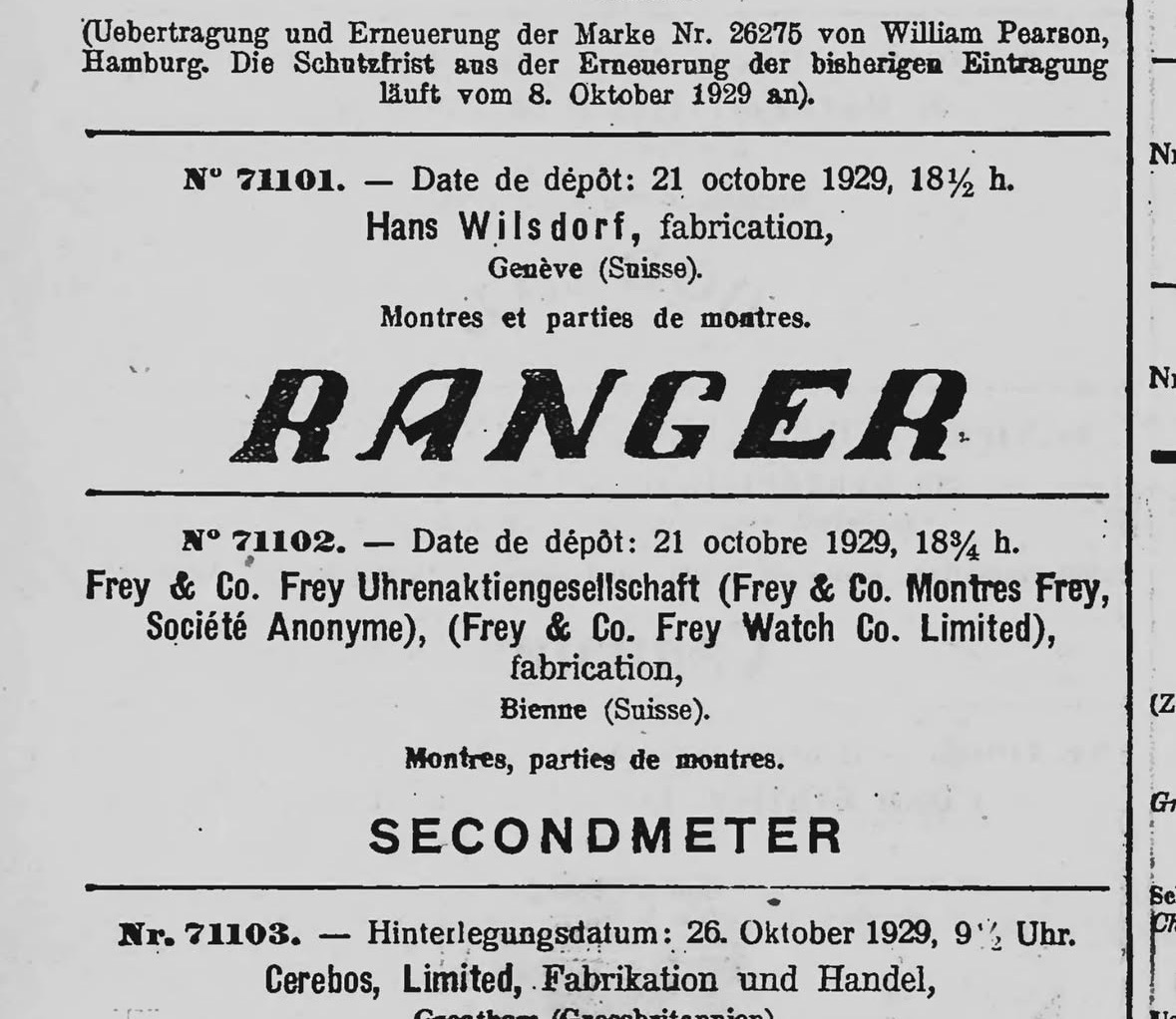
The original registration for The Ranger trademark from 1929 (IG: @Niccoloy)
Interestingly, the vintage Rangers interestingly didn’t have their own allocated reference number. Instead, they shared the cases, crowns, movements and crystals of standard Tudor dress watches. Yes, undoubtedly there were specific Ranger reference numbers, but there many more non-Rangers produced with these case references. This is why a vintage Tudor Ranger can be one of the trickier purchases for collectors. For many years unscrupulous sellers have been buying after-market Ranger dial and handsets and installing them in authentic Tudor dress watches that shared the Ranger reference numbers. There are some small details that the trained eye can spot though, and I get asked for my opinion on Ranger watches more than any other model. You can read my vintage Ranger info here.
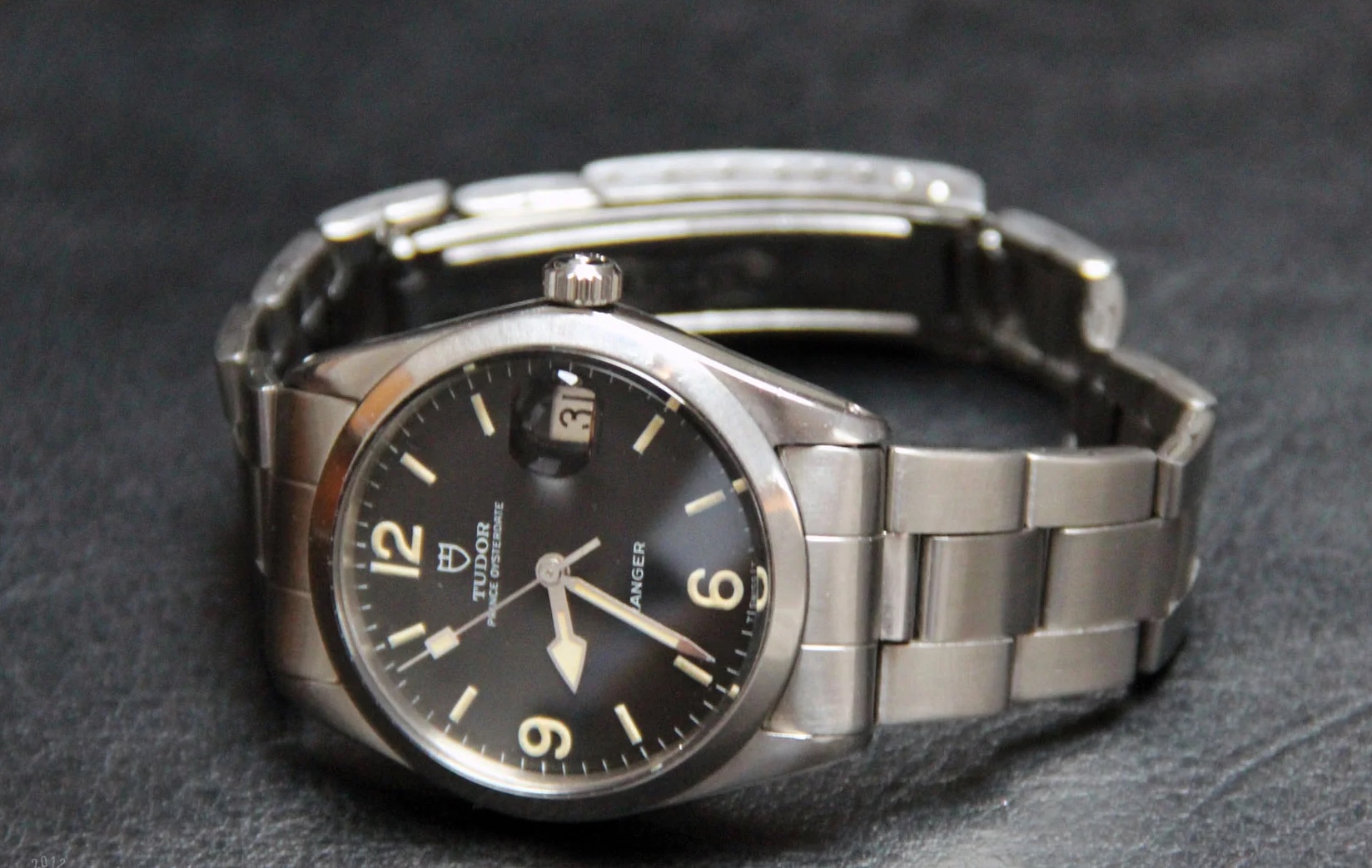
Prince Oysterdate Ranger (Tudor Collector)
The vintage Ranger was available in both date and non-date models and were nominated as Ranger Prince Oysterdate, Ranger Oyster Prince and the Ranger Oyster (Prince referred to the watch being automatic – there was not a manual wind date model). The earliest ‘Rose’ dial watches were non-date and were marked Ranger Self Winding (the Self Winding in the familiar half circle shaped layout, beneath Ranger). The ‘Shield’ dialed models were simply marked ‘Ranger’ on the bottom half of the dial. The printing of these dials is unmistakable and under inspection via a loupe is reminiscent of the printing style of the matte dialed Submariners of the same era. The hands were developed especially for this model and had a very distinctive arrow-shaped hour hand and soft oblong seconds hand. Late into the model’s production in the 1980’s the Ranger was allocated it’s own reference number for the non-date models, 90330 and 90220.
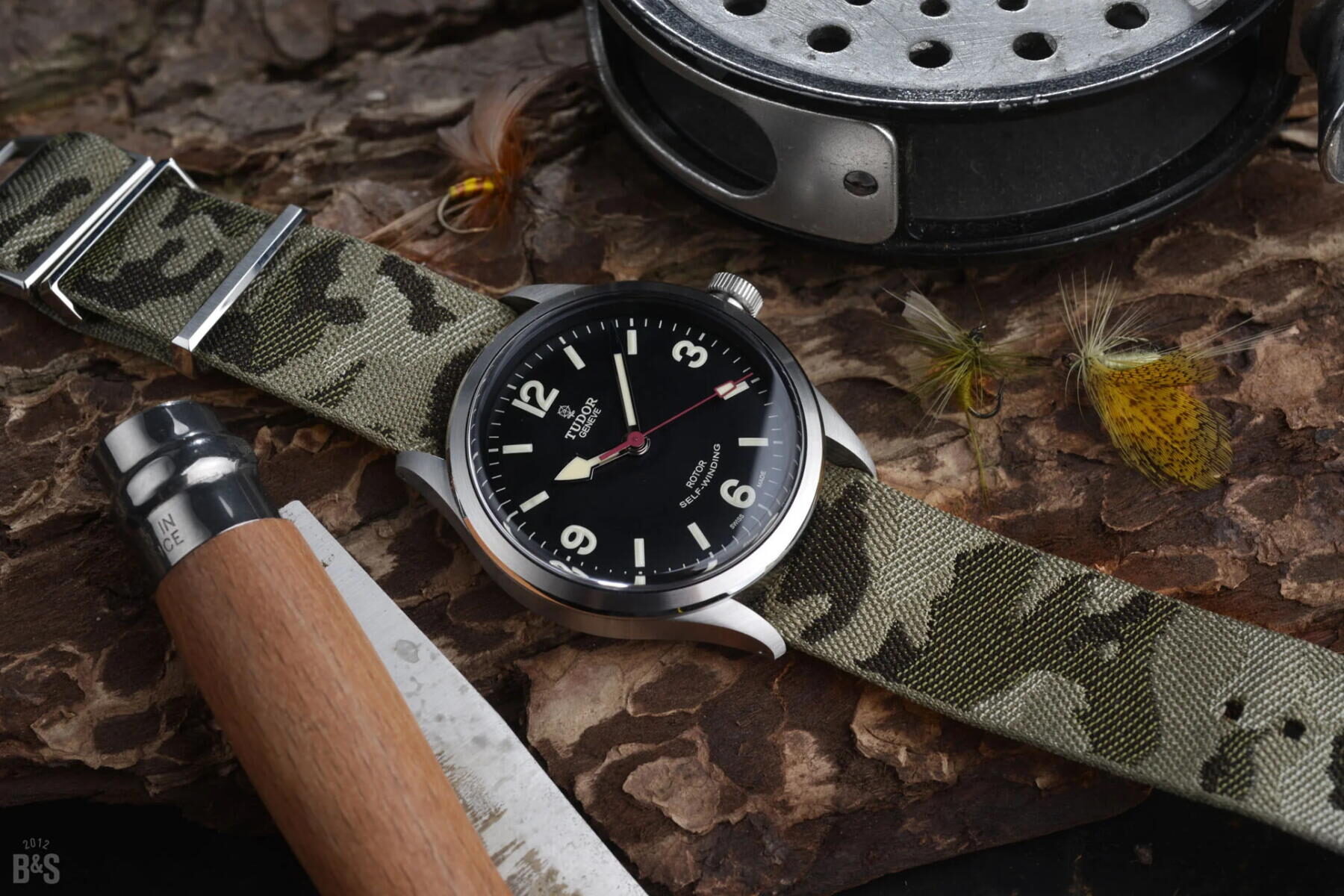
2014 Heritage Ranger (B&S)
The Ranger Returns
Then in 2014, under its Heritage line, Tudor unveiled a new Ranger. The case has been updated to a robust 41mm and the watch featured a slightly domed sapphire crystal and dial with subtle domed shape and the hand-applied luminous markers. As much as the vintage cues were there with the dial, which did not actually mention Ranger, similarly Tudor were making strong reference to their history with the bracelet. In the early 1950s Tudor watches were fitted with Oyster bracelets with straight end pieces that left a gap between the end of the bracelet and the case. This was addressed by the introduction of the flush-fit end piece, which filled the gap left by earlier bracelets. The Ranger’s metal bracelet had straight ends, which was another appealing heritage feature. Maybe due to its size, the watch was discontinued after a few years.
The Revenge of The Ranger
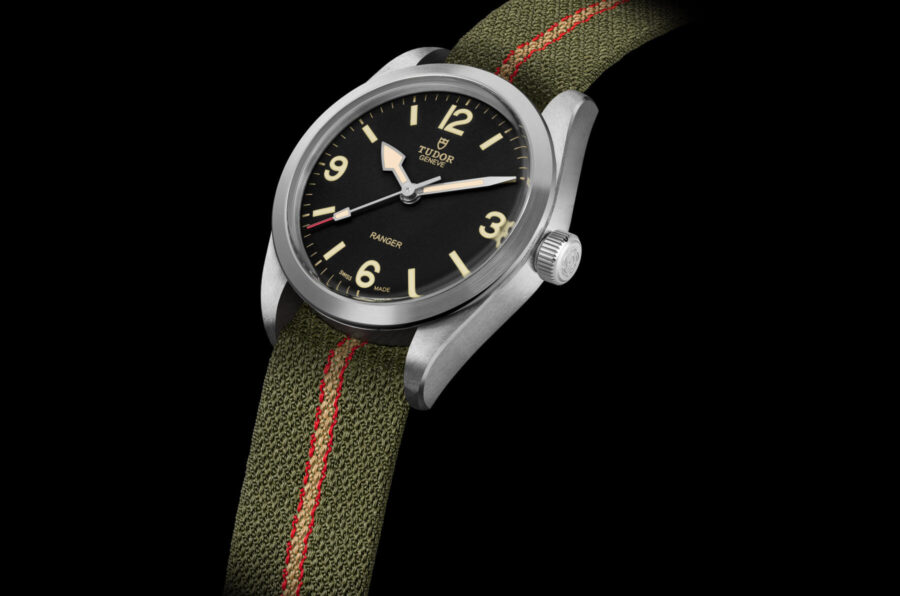
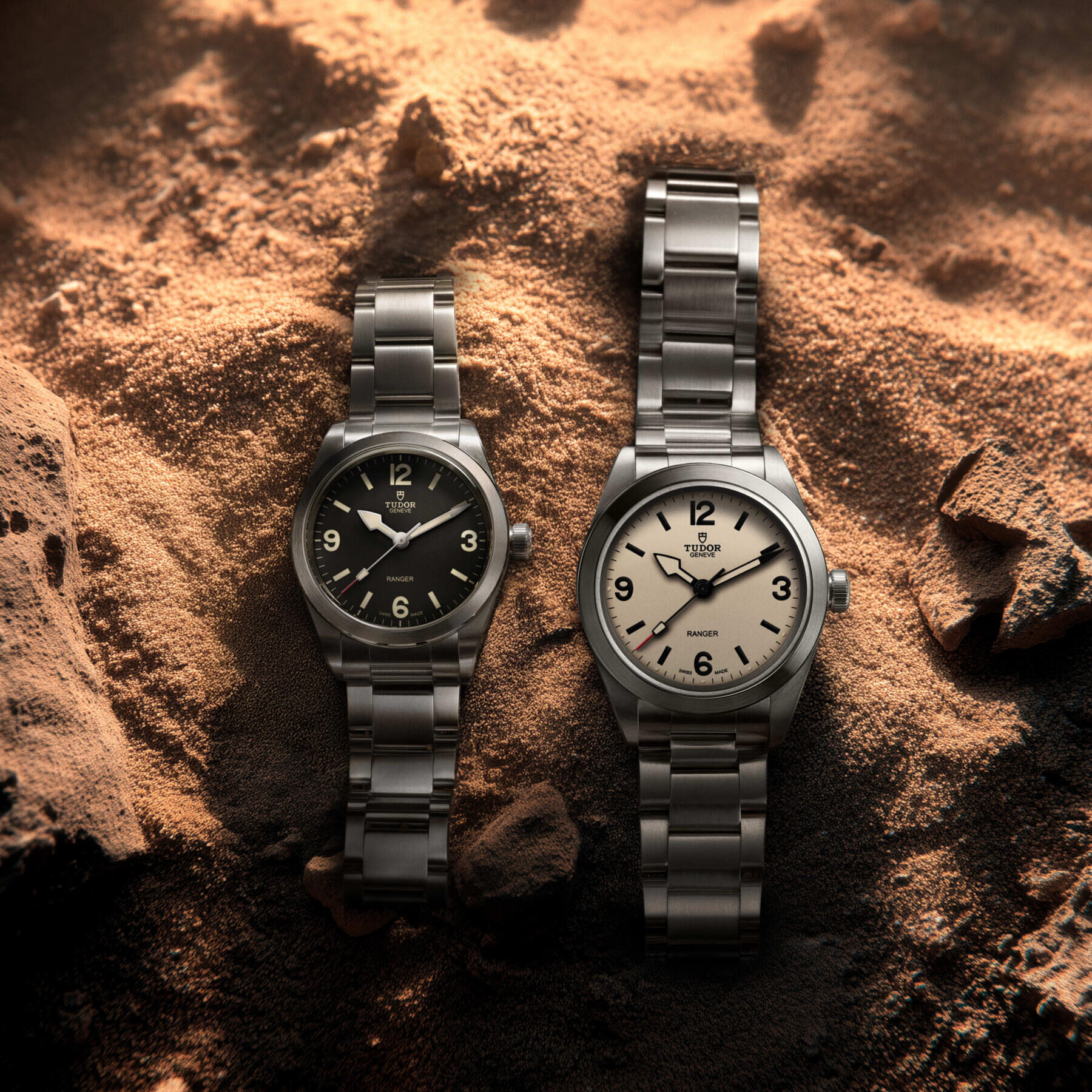
Then to mark the 70th anniversary of the BNGE, in 2022 Tudor relaunched the Ranger, this time wearing the moniker proudly on its dial. Reducing the case size a little, to 39mm, the watch was much more faithful to the original Ranger. The all-brushed case and reworked dial were instantly hugely popular with collectors. The only gripe being the case size, still a lot bigger than the original 34mm watches.
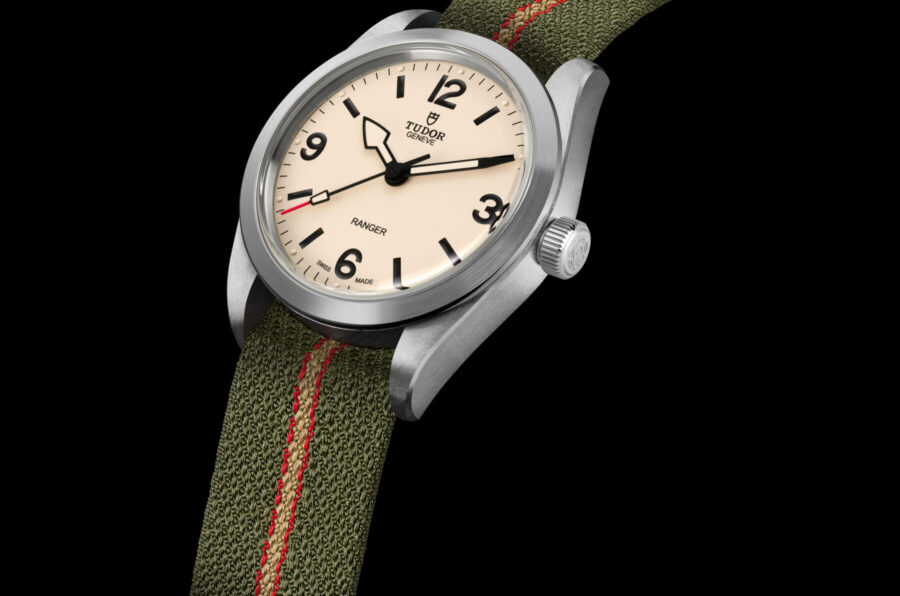
2025, however, remedied that with the introduction of a 36mm case version of the Ranger, with a sand-hued dial version called Dune White. As expected, the watch community went crazy for the watch. The launch coincided with Tudor’s partnership as official timekeeper for the 2025 Dakar Rally. In nice synergy, the watch was launched at Dubai Watch Week 2025, making the Dune White version very apt for the location and partnership.