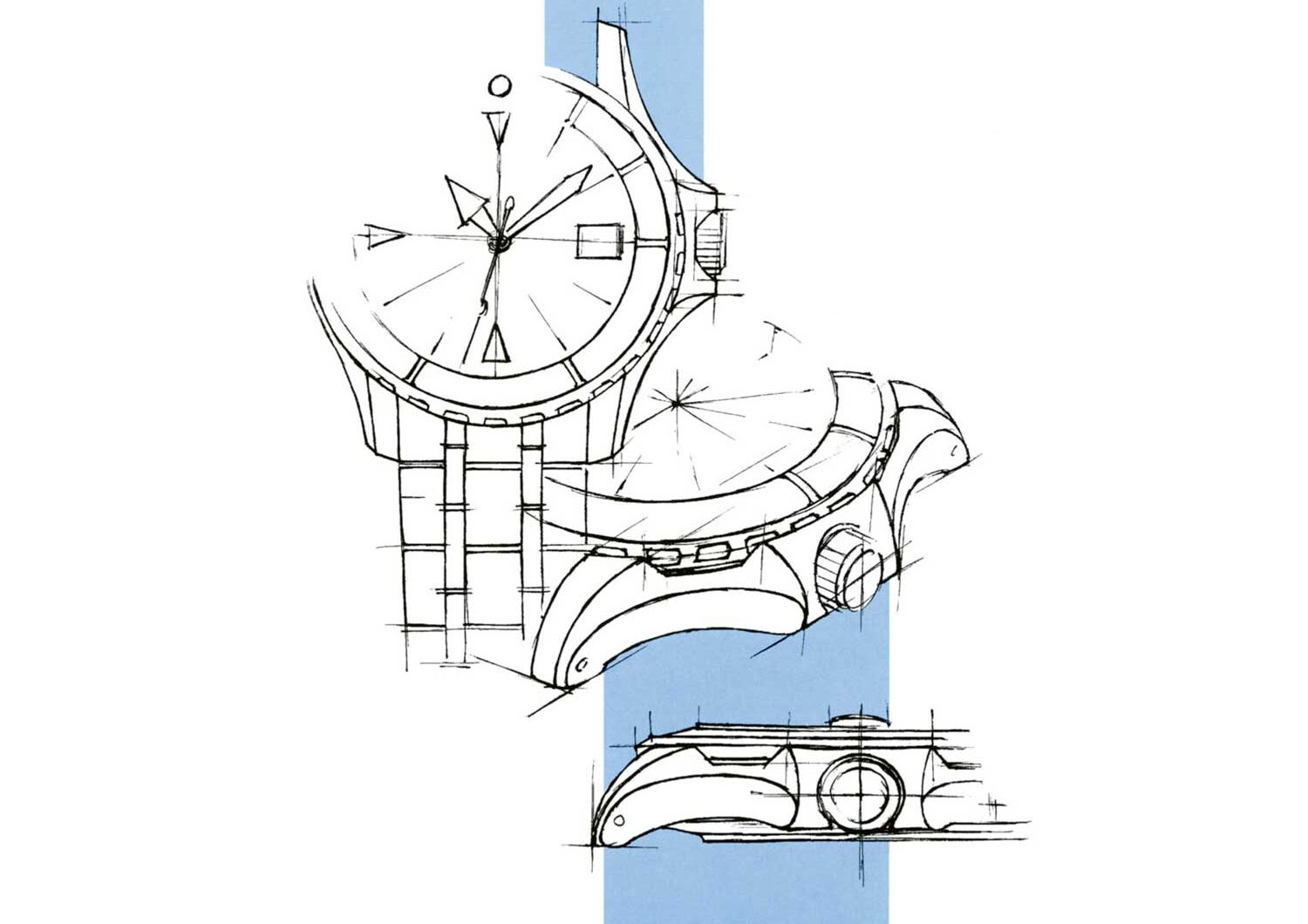
Tudor’s Nauty Noughties
After the Submariner and ‘Small Block’ Prince Chrono era of the late 90s, in the 2000s Tudor tried and tested the market with a number of non-Rolex derived models that were phased out with the launch of the Heritage line in 2010.
For many, the post Submariner and pre-Heritage era Tudor watches are a combination of “what is that?” or “wow, never saw that”. The brand was withdrawn from sale in two of its biggest markets, the US and UK, for over a decade and so familiarity levels are generally quite low for these models. The early 00s era of Tudor’s output is very different to the Submariners and Chronos that preceded it, with many pieces you may not have even heard of and most likely won’t be aware of all the iterations that were made. Maybe I’m not either!
The word “naut” is most commonly used as a suffix. Its most well-known use is probably astronaut or cosmonaut. Over the years we have learnt of the adventures of aeronauts, aquanauts, oceanauts and even gastronauts. In the spirit of adventure and interesting journeys, Tudor created its own ‘naut’ watches in the Hydronaut, Aeronaut and Iconaut. The Hydronaut replaced the Submariner in the pantheon of dive watches. The Aeronaut and Iconaut were a new chapter and represented Tudor’s first foray into the world of traveller watches; more specifically the dual-time zone complication or GMT.
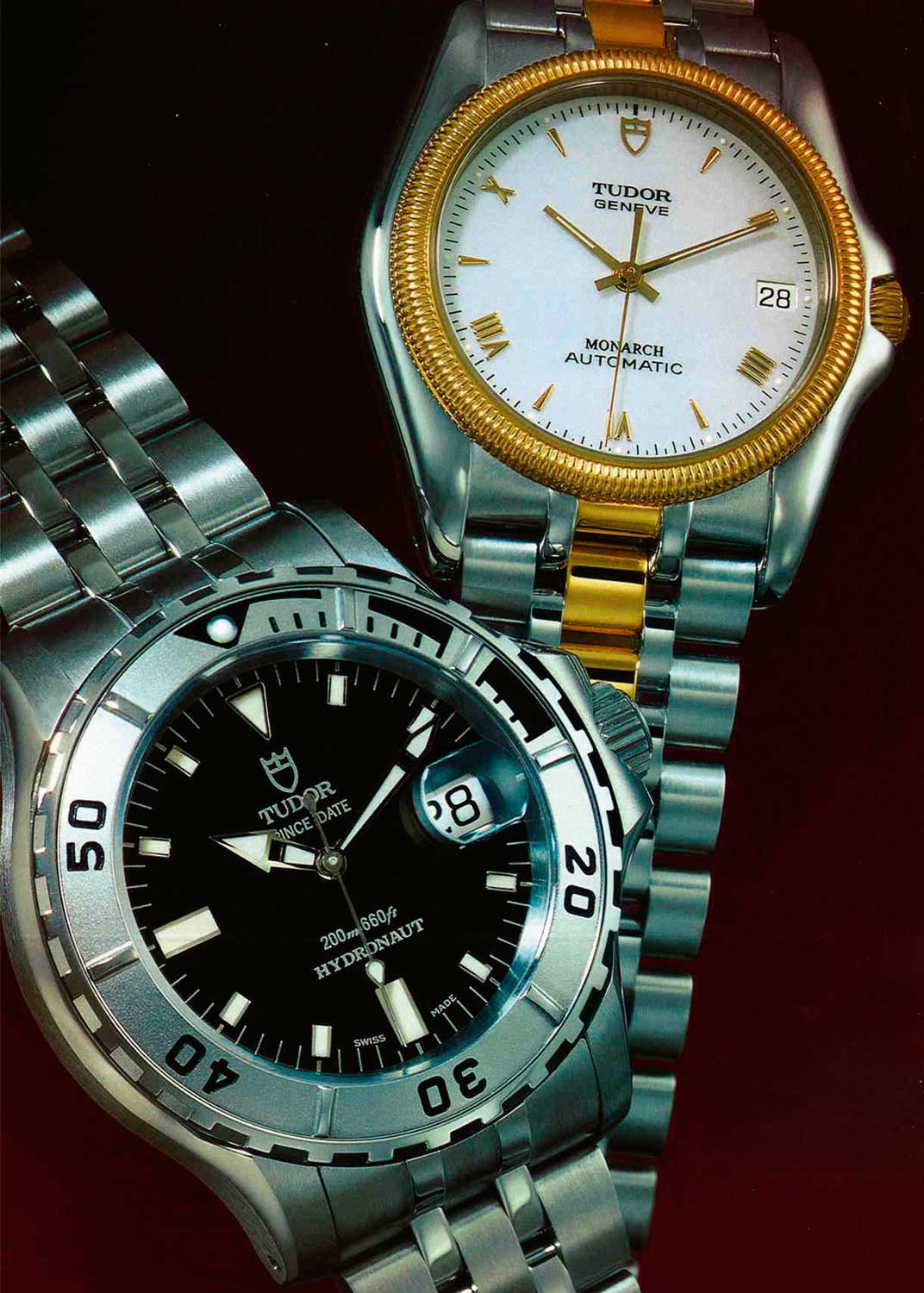
In the mid-2000s Tudor were producing watches that were still faithful to the Oyster-based wristwatch that was the Wilsdorf Stable’s staple, but developed into a new silhouette with a profile more akin to the then-revamped Rolex sports watches, such as the Submariner and GMT-Master. Thicker lugs and increased case sizes were the new recipe, with very often more than a sprinkling of diamonds!
A Hard Act to Follow
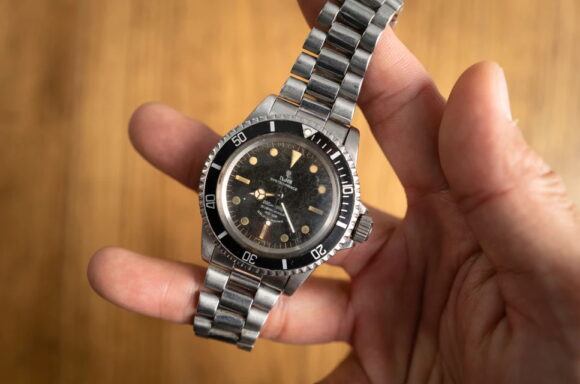
The Submariner is arguably the most iconic of all dive watches. I don’t use the term ‘iconic’ lightly, but I think you’ll agree that whilst it might not have been the very first watch of its kind, no other model has had the long-lived impact of the good-old Subby. One could be forgiven for thinking that in fact, the Submariner name was dropped in honour of the Black Bay, but in fact there is a chapter that precedes the Black Bay, namely the Hydronaut. In 1998 Tudor dropped the full size Submariner reference 79190 and replaced it with the reference 89190 (although the mid-size 36mm 75190 Submariner and 33mm 73190 Mini Sub were still available). The watch was simply badged as a Prince Date for the first year and catalogued as the Prince Date Diver’s Watch. The watch was a drastic reinterpretation of Wilsdorf’s classic diver with a rounder case profile and a midcase that almost wrapped around the uni-directional bezel at both ends near the lugs. Gone too were the Mercedes pattern hands, replaced with a flanged minute hand and large arrow hour hand. The Prince Date did, however, maintain the round and triangular format hour markers that was a trademark of the post-Snowflake Tudor Subs.
This was also the time of Tudor’s involvement with professional golfer Tiger Woods. In a move, quite unthinkable before or since, the 89190 and the Small Block chronographs of the era had TIGER on the dial. The TIGER dial 89190 had the round and triangular hour markers and so I’m pretty confident that these watches date to 1998, or at least the dials were made during that year.
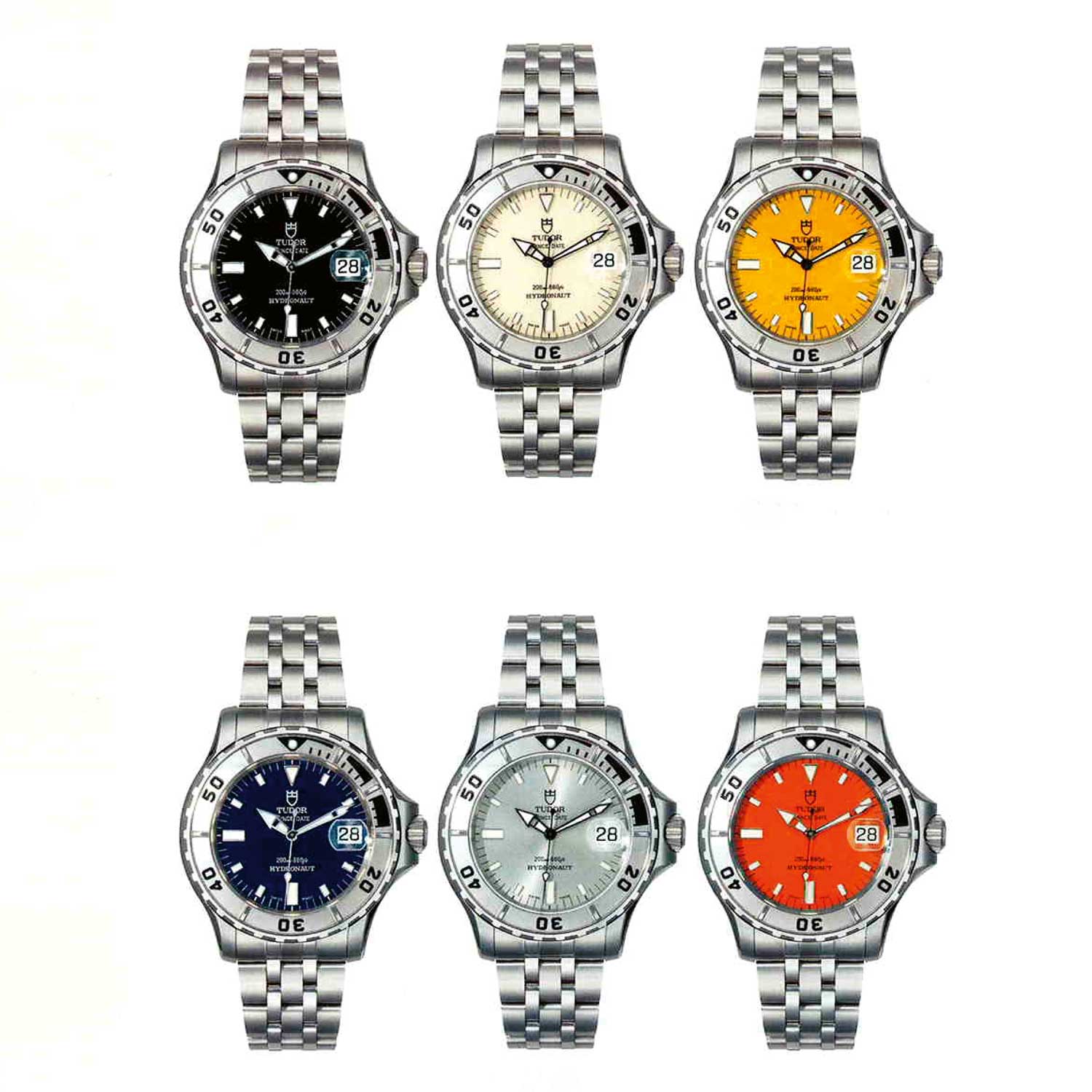
In 1999 the reference 89190 was reborn as the Hyronaut. With the Hydronaut also came a new dial that featured rectangular hour markers with large stripes of Super LumiNova through the middle. One element of the classic Submariners that did appear in the 1999 Hydronaut was the use of blue bezel inserts with blue dials and black bezel inserts with black dials. The other dial colours had a steel insert. From the 89190’s introduction in 1998 in the Pre-Hydronaut, the use of colour on the dials was prevalent. Much like the Small Block chronos, dials came in vibrant yellow, shocking orange, cream and silver. There were also mother of pearl dials in white, pink and blue and also a carbon fibre black dial.
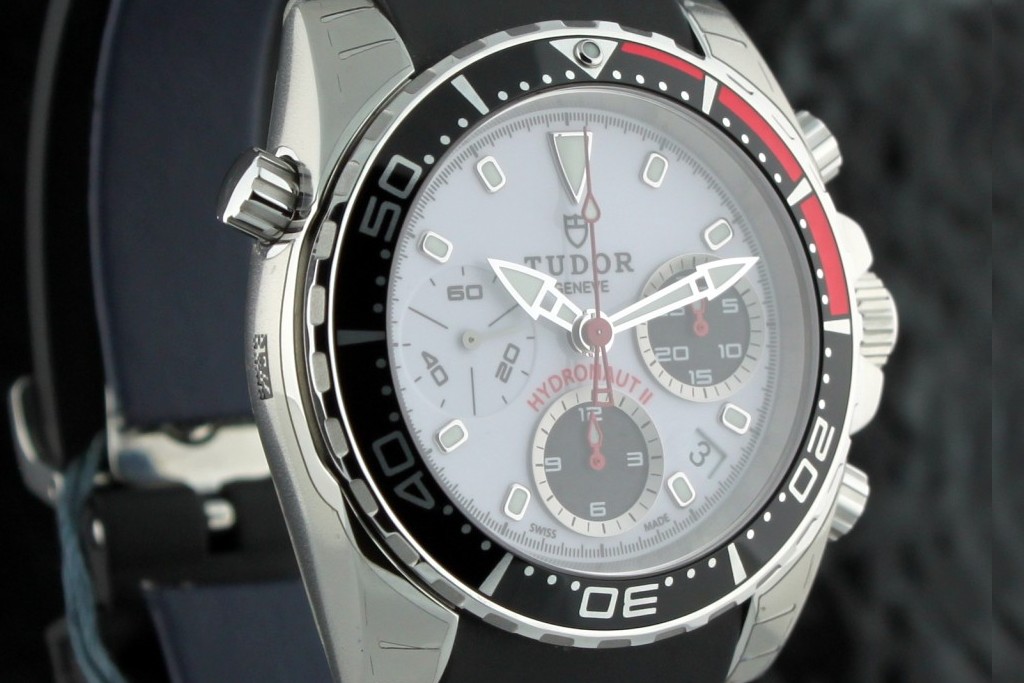
2007 was the beginning of the second chapter of the Hydronaut. The sequel came in the guise of the Hydronaut II, a watch that didn’t veer entirely off course but was still quite different to the watches that had gone before. Tudor has never stopped being part of Rolex and the Hydronaut II came a year before Rolex launched the maxi-case Submariner, with its wider lugs and crown guards. Interestingly, the Hyronaut II was relased a year before the Rolex maxi-case Sub although the first Rolex maxi-case came with the GMT-Master II in 2005. The Hydronaut II was, however, very much part of that zeitgeist and had flatter, wider lugs and pronounced crown guards.
The Hydronaut II was given the reference number 20040 and had plain baton-style hands and similar applied hour markers to its predecessor. The watches had an interesting steel bezel with recesses every five minutes after 15 with the numbers printed in relief. Reference 20040 had a satin finished bezel and there was also a reference 20030 with a polished bezel. In terms of bracelets, there were two steel bracelet choices, the reference 93570 Jubilee-style bracelet and also a here-link flip lock bracelet reference 95000. For a more sporty, dive watch aesthetic there were black or blue bruuber straps on steel deployment clasps.
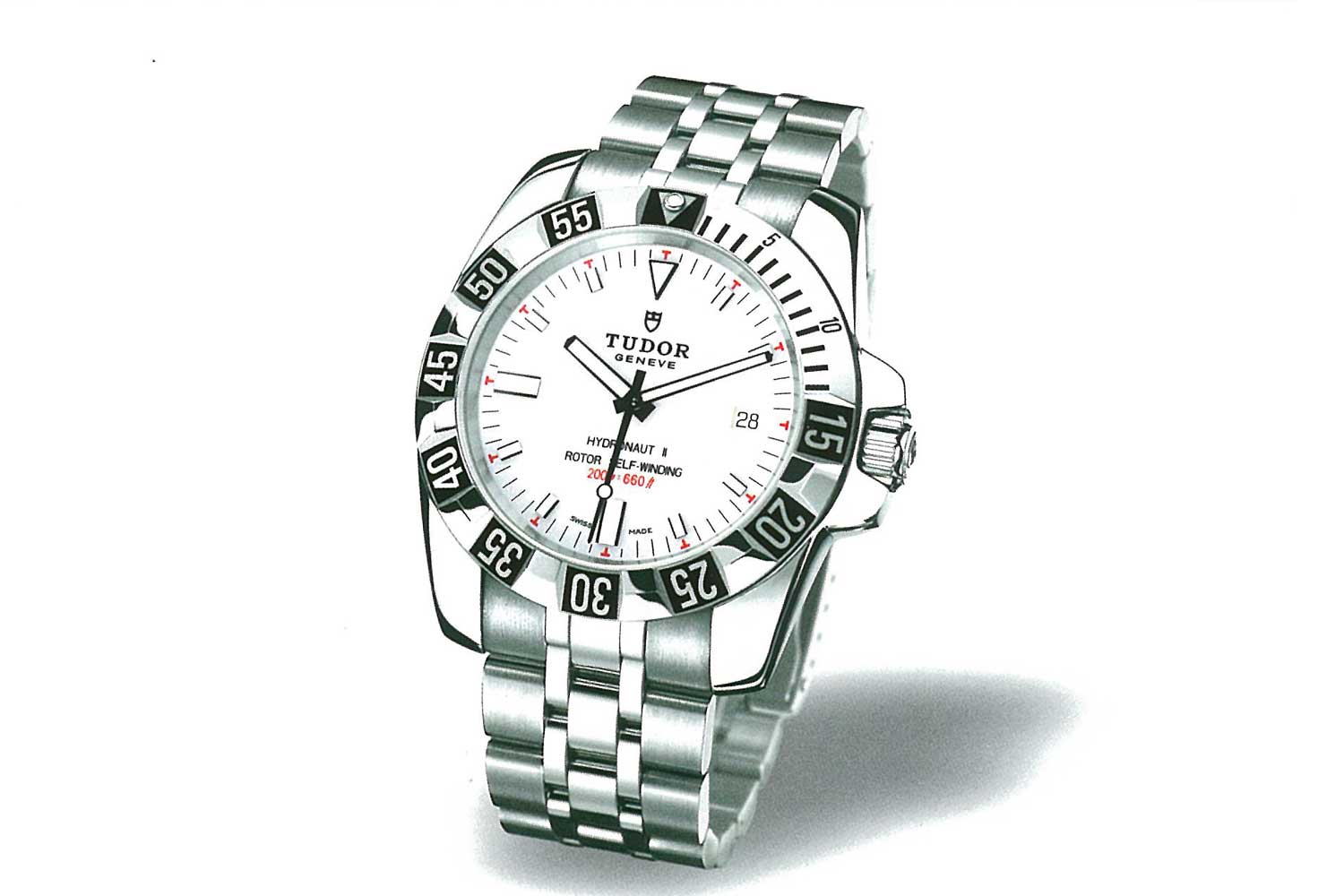
The final chapter for the Hydronaut came in 2010, which was the same year that the Heritage line was born with the incredibly popular Heritage Chrono – a riff on the vintage Homeplate chronograph from 1970. Released as reference 20060, the watches had bezels that were more like the very first Hydronaut from 1999 with a more classic styled insert but with striking red sweep between 12 o’clock and the 15 minute marker. The classic 89190 hands also made a return but with a red centre seconds hand. The watch was pretty short lived though, as in 2012 the Black Bay was released, and we all know what happened after that!
A Nauty Chrono
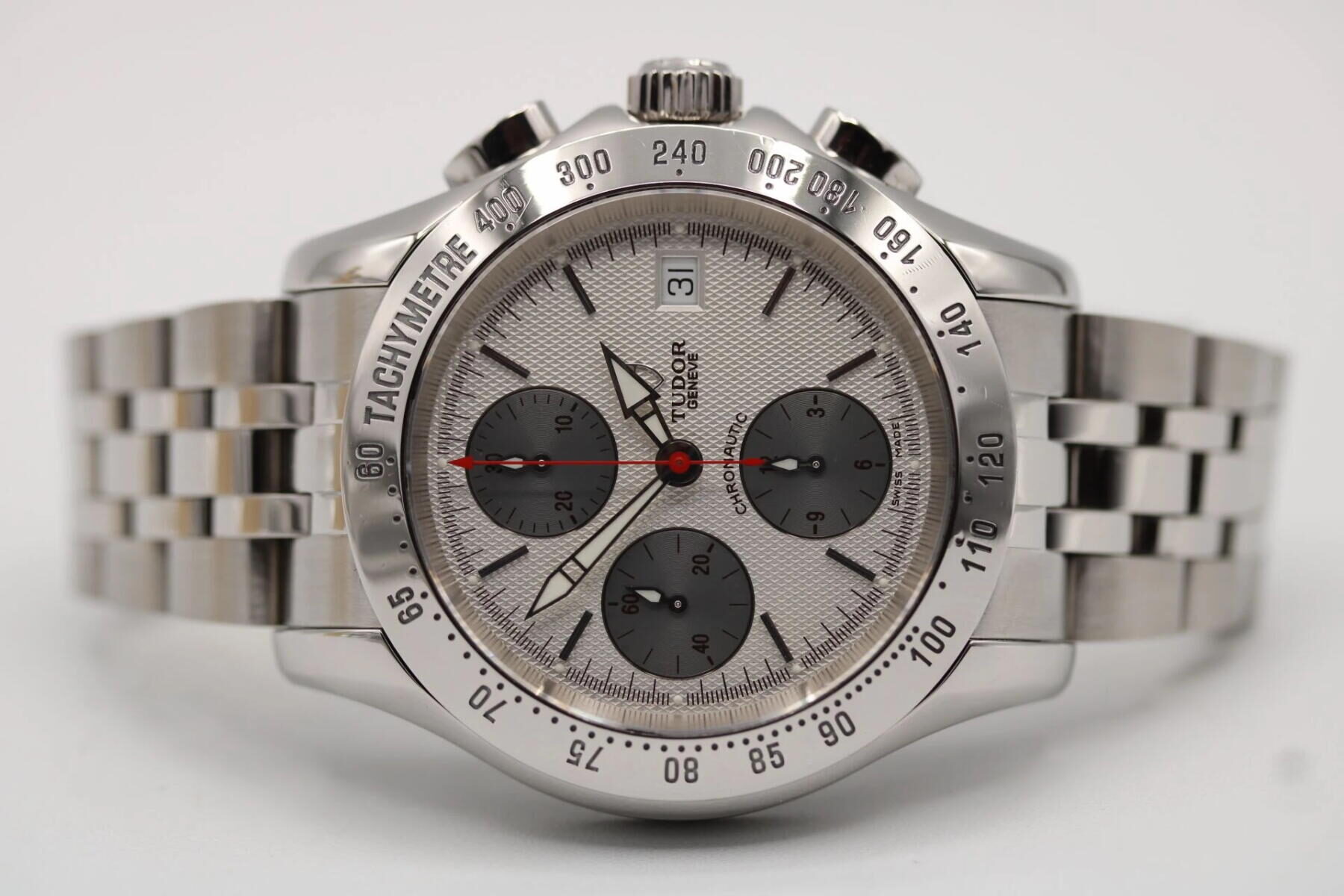
In 2002, when the now desirable Small Block chronograph was still widely available in the market, Tudor unveiled the reference 79380 chronograph that was given the collection name Chronautic. Where the Small Blocks were heavily influenced by its sibling Daytona, the Chronautic had a completely revised case. Like the Hyronaut had moved on from the Submariner aesthetic, the Chronautic adopted olive-shaped non-screwdown pushers amd a case shape that rose up to meet the bezel, much like the Hydronaut.
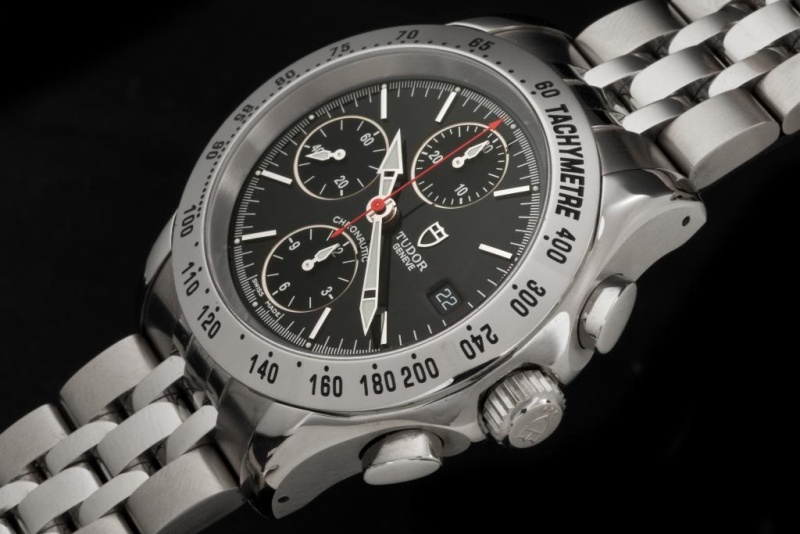
Other subtle changes included arrow hands and the replacement of “Units Per Hour” on the bezel with TACHYMETRE. The watches were available on either a five link steel bracelet with concealed clasp, or on leather strap with the removeable fixed endpieces that were introduced with the Small Block chronographs.
Tudor’s GMT is Born
The launch of the Black Bay GMT in 2018 was heralded as smash hit for Tudor, with a ‘family’ launch alongside the release of the Rolex ‘Pepsi’ GMT-Master. Where the Rolex Pepsi bezel was manufactured from the 21st century ceramic, its Tudor stable mate was fitted with a vintage-style aluminium insert that gave the watch a true heritage look. Many headlines celebrated the first GMT watch from Tudor, but in fact this wasn’t the case. During Tudor’s interregnum from the UK and US markets, they were still producing watches for the Far East and European mainland. One such model was the Iconaut – a 43mm beast of a watch with dual time-zone complication.
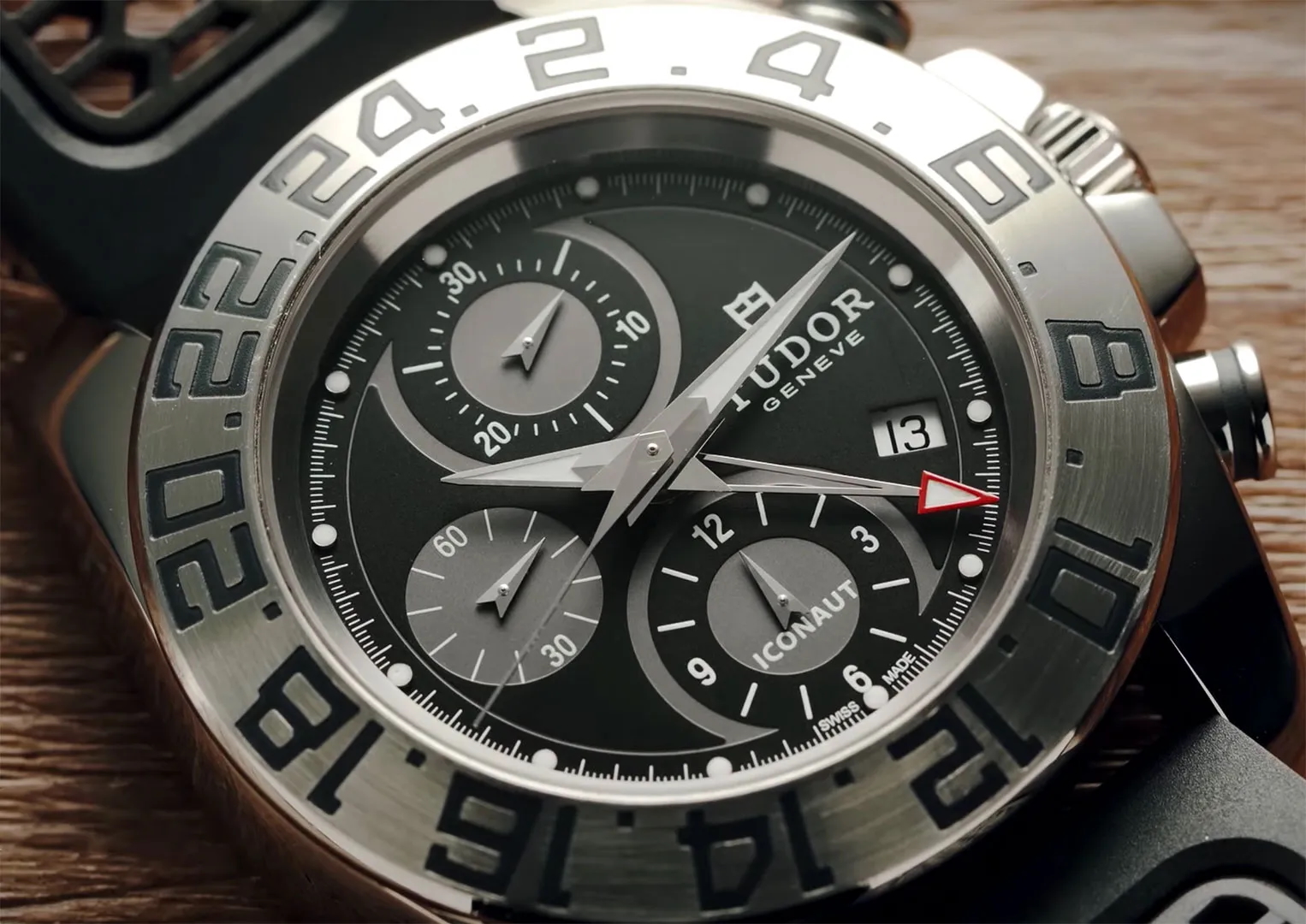
The Iconaut was released as reference 20400 and was both a sports chronograph and a dual time-zone watch. It was housed in a steel case measuring 43mm with 22mm lugs and was waterproof to a depth of 150 metres. Driven by a modified valjoux movement, the Tudor calibre 7754, it was the brand’s first multi-functional sports watch. You could dive in it, time your racing car and monitor two time-zones. It really was the horological Swiss Army Knife!
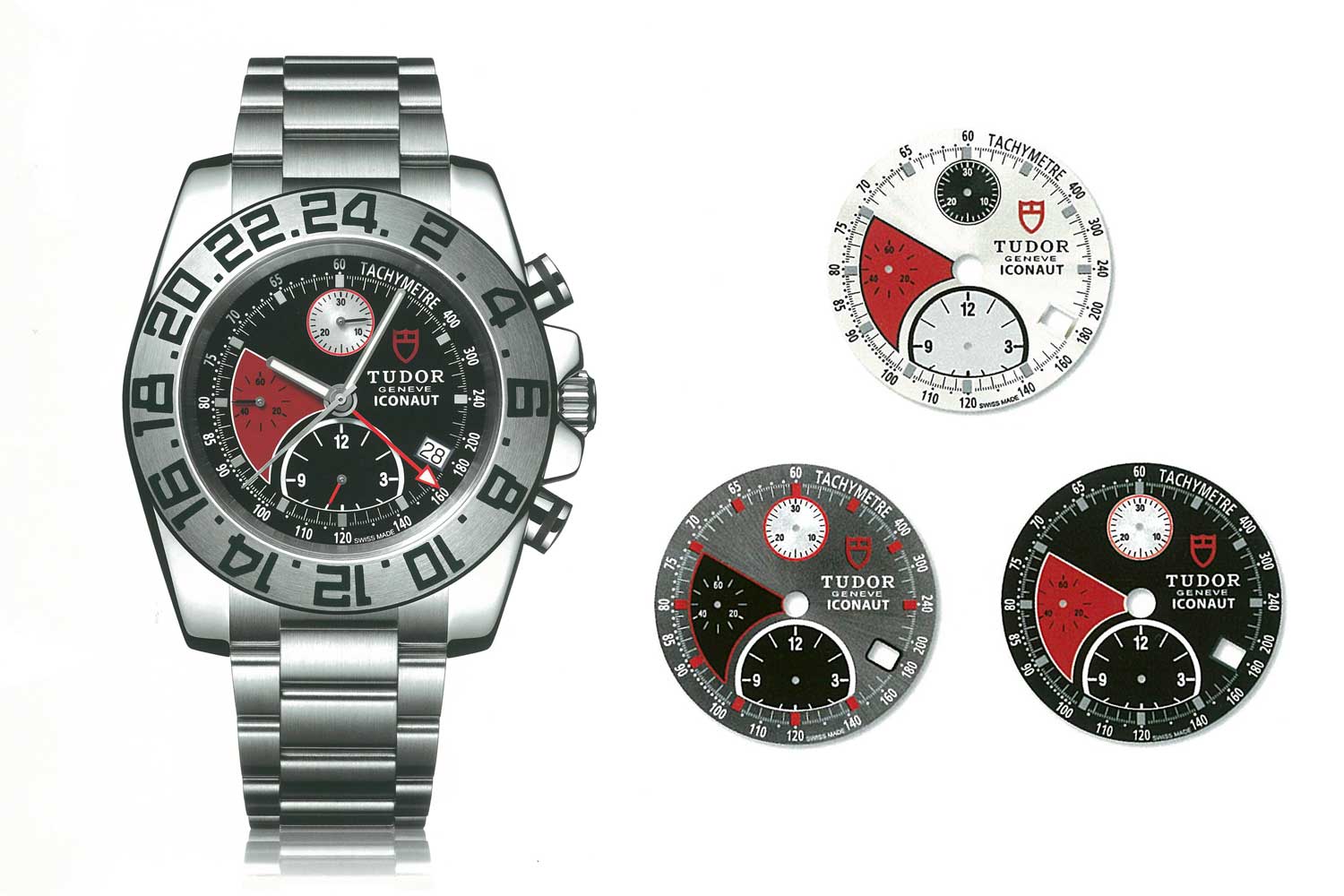
The most common version of the watch featured a striking dial layout with, what I see as, an upside down shark fin at nine o’clock. Tudor referred to this as the ‘Deco’ dial in the master catalogues, the deco refering to the shark fin area. The watches were available with three variation of dial – black, white and grey (called Black Sun in the catalogues). The within this shark fin is a running seconds hand. The top sub dial is a 30-minute register and at the bottom of the dial an elapsed hours register. The centre seconds hand as the stopwatch seconds hand, which also functions for the tachymeter reading. Large, almost ‘exploded’, 24-hour numerals are painted onto the fixed steel bezel.
There is another Iconaut that was given the name Iconaut Speed. This was essentially the same watch with the same reference, 20400, but had a different dial and had the option of a black perforated rubber strap with pin buckle. The dial was either all-black or black with grey sub dials. The watch also had different hands that were shaped like arrows. I am unsure if referring to these as ‘rarer’ is actually true, but certainly there are fewer available out there as far as my research indicates.
Bracelet was the only option for the standard, non-Speed Iconaut. The 22mm lugs meant that a unique bracelet reference was needed, the 95010. Oyster-esque in many ways, the bracelet is also similar to the precious metal only President band from the Day-Date. This steel bracelet was almost an amalgam of the two. The 43mm Iconaut case was the biggest waterproof case to come out of the Wilsdorf family until the introduction of the Rolex Deepsea Seadweller. The vintage Tudor Big Block chronos were the thickest, but the Iconaut was the widest.
Another GMT
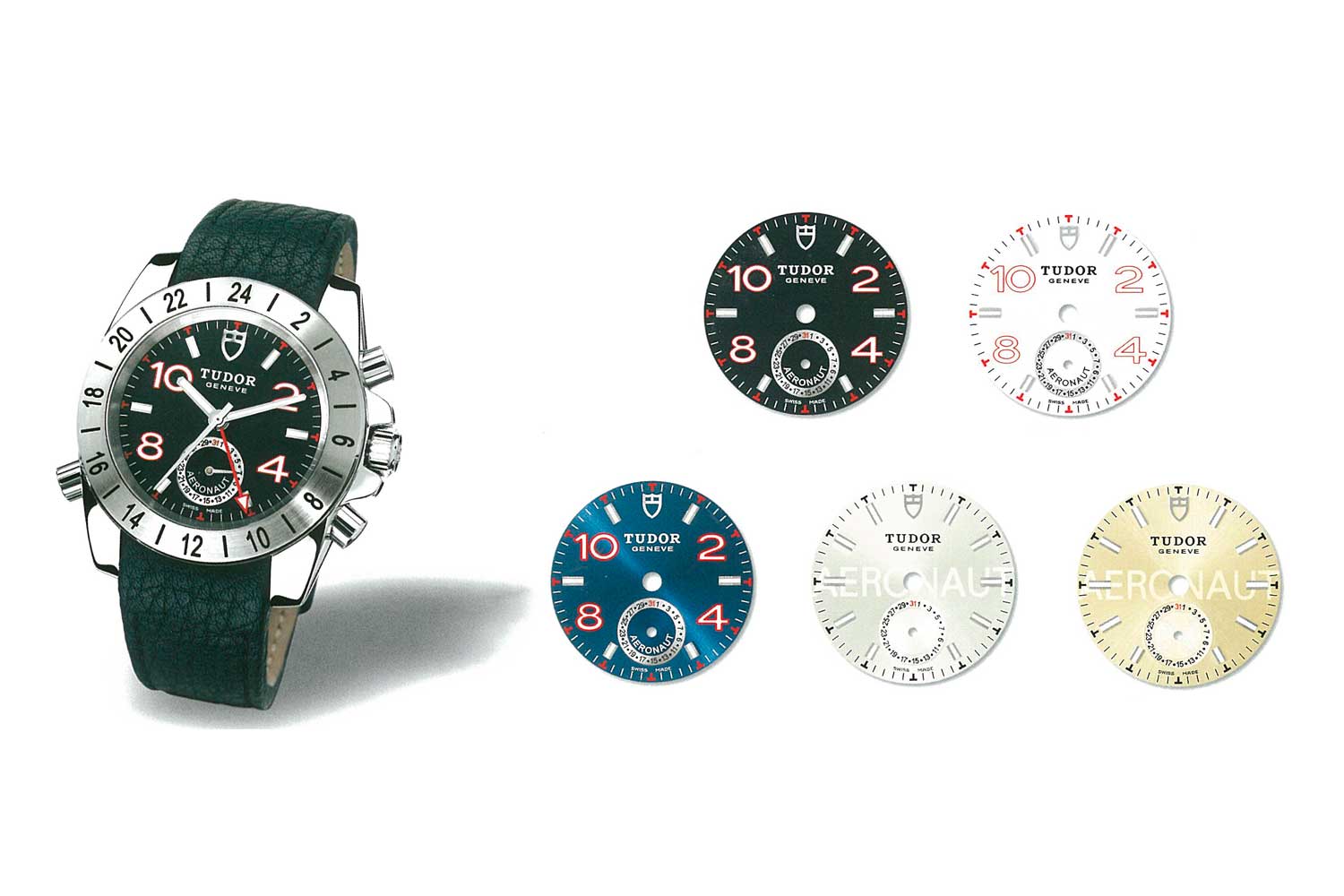
In 2006 a new watch was born and in fact this watch could have been the off-spring of a Rolex Daytona 116520 and an Explorer 2 16570. The Aeronaut was given the reference number 20200 and was housed in a 41mm case with 21mm lugs. Sound familiar? Yep, just like the modern Rolex Submariner. The Aeronaut enjoyed the silhouette of a chrono, albeit with an extra pusher, and yet was a true GMT watch. The pusher of the time in Tudor sports watches with a hybrid of early Oyster pump pushers and later screw down pushers and were unlocked by a quarter turn.
On the Aeronaut the two o’clock pusher could be used to advance the hour hand – one click moved the hour hand forward by one hour. The pusher at four o’clock took the hand back by one hour. Simple and an easy way to adjust to new or changing local times by the intrepid traveller. The third pusher was located at eight o’clock and could be used to advance the date, a click and a day at a time. The screw down trip-lock crown had the usual functions of winding the watch and setting the time and was the method by which one could move the red 24 hour hand.
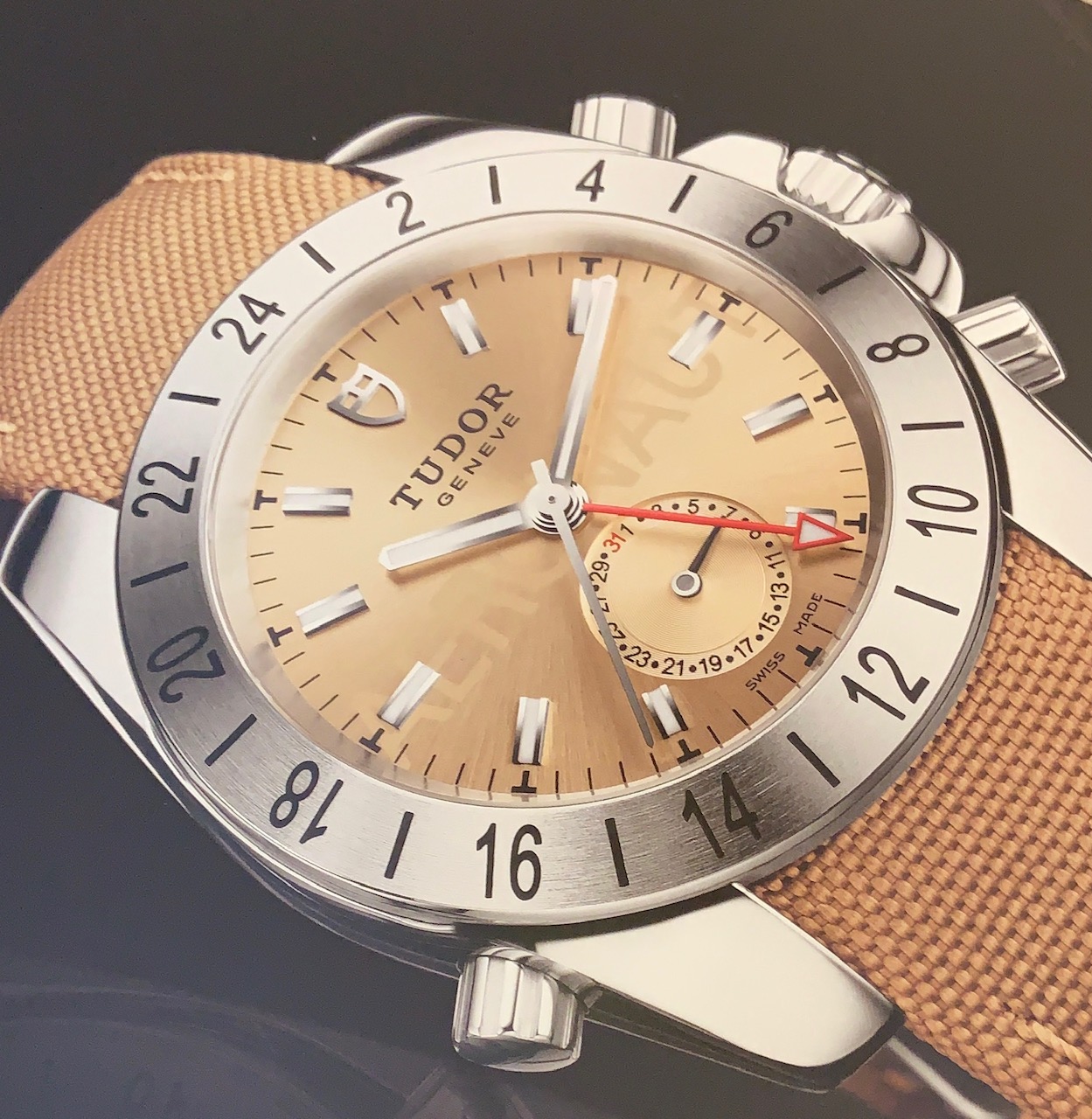
The 41mm case had wide polished lugs and a brushed fixed 24-hour bezel. The movement was a modified ETZ calibre 2892-A2. There were essentially two different dial layouts for most of the 20200’s lifespan. A silver or champagne version with applied hour markers and the word AERONAUT across the entire width at the centre of the dial in of the dial in a lighter shae of either silver or champagne. A sub dial at six o’clock was the date. At the very edge if the dial at the hour markers were small letter ‘T’s. The other dial type had painted arabic numerals at 2, 4, 8 and 10 with AERONAUT in an arc within the date sub dial. The outline of the arabic numerals was in striking red with complimentary red ‘T’s on the dial edge at the hour markers.
The Aeronaut had an astonishing five different strap options that could be colour matched to the dial. There were two steel bracelet choices, the reference 93570 Jubilee-style bracelet that was also used on the Prince ‘small block’ chronographs in the 1990s and also an Oyster-esque flip lock bracelet reference 95000. One could also choose calf leather in black, red, blue or brown or what Tudor called ‘Tissue’ in charcoal or beige. This was essentially a nylon-topped stitched strap. Finally, there were blue or black rubber straps with TUDOR on the upper edge. All three strap types were fitted with a steel Tudor deployment clasp.